Posts

Lion Population Re-established at the Samara Private Game Reserve

Samara Private Game Reserve is now home to the Big Five, as their founder pride of lions arrived on the reserve on the 29th of November 2018. They are thrilled to be re-establishing a lion population which had been locally extinct for 180 years.The Award-winning Samara Private Game Reserve is a luxury malaria-free safari destination with a passionate conservation mission set on 70,000 acres of breathtaking wilderness in South Africa’s Eastern Cape. Located just north of the famous Garden Route and 40 minutes from South Africa’s 4th oldest town of Graaff-Reinet, Samara offers a rejuvenating and pampering safari experience with a greater conservation purpose, delivering a safari for the soul.

Photo credit: Samara 

The lion population declined in numbers by 43% over the past 24 years. The current population is estimated to be between 20,000 and 30,000 individuals. Lions face a number of threats, all thanks to humans. Humans orchestrate indiscriminate killing in areas like the Maasai Mara, whilst the bushmeat trade and habitat loss deplete the lions’ prey base. Further pressure on the species stems from the trade in lion bones shipped to the Far East, where lion body parts are sold under the guise of being tiger bones in traditional medicine. This illegal trade has fuelled South Africa’s ‘canned lion’ industry.

Photo credit: Samara 

The ‘canned hunting’ industry refers to the act of shooting captive bred and/or tame animals in confined areas. The term canned hunting came into popular use in 1998 after the Cook Report, a British current affairs television programme, featured footage of a lioness being shot several times within a small enclosed area. The term soon became synonymous with any form of trophy hunting where hunters shot animals within confined areas, ensuring they had no or little chance of escape. Today, canned hunting is widespread in South Africa. Large numbers of wild animals are being bred in captivity specifically to be shot. This is truly terrible, and is the reason why sanctuaries like the Samara Private Game Reserve need to exist and thrive.

Photo credit: Samara 

Samara’s founder lion pride will consist of several unrelated males and females to ensure genetic diversity. The lions’ movement, feeding and breeding patterns will be monitored through satellite technology and by researchers on the ground. The Samara experience will always be about more than just ticking boxes and chasing the world’s most famous megafauna (large mammals of a particular region, habitat, or geological period), but re-introducing contributing meaningfully to conservation and responsible tourism, as well as adding an exciting new dimension to their safaris. Samara is already home to elephant, black (and white) rhino, buffalo and the occasional leopard. We are excited about their new lion pride and if you’d like to visit the game reserve, get in contact with us today.
Top 5 Game Reserves to Visit in Summer

Come summer in South Africa between December and March, Addo Elephant National Park, Gondwana Game Reserve, Hluhluwe Game Reserve, Pongola Game Reserve and Shamwari Private Game Reserve are the best reserves to visit. Whether you are planning on going on safari for the first time or you’re a returning game reserve visitor, we know that these game reserves are not to be missed. See the Big 5, learn about their various conservation programmes, view wildlife while lounging on a boat, go bird watching and much more while visiting these reserves. Here’s our list of best game reserves to see in the summer…

1. Addo Elephant National Park

Situated on the Garden Route, 72km (one hour’s drive) away from Port Elizabeth and malaria-free, Addo is a good option for families. Here you can see the famous Addo elephants as well as mile after mile of verdant citrus trees, bearing fruit all winter and scenting the air with their blossoms in springtime. Established in 1931 to save 11 Elephants on the brink of extinction, Addo is now home to one of the most dense African elephant populations and currently has about 550 elephants.

Other than being a sanctuary for African elephants, the park is also home to 280 Cape Buffalo, some black Rhinos, a range of Antelope species, as well as the rare flightless dung Beetle. The game viewing and outdoor activities, includes horse-back riding, guided walking, hiking and 4×4 trails and a picnic area for day visitors. Recently, the Addo Elephant National Park has expanded to become the only park in the world to lay claim to Africa’s ‘Big 7’, which are the elephant, rhino, lion, buffalo, leopard, southern right whale and great white shark. This park is full of life and adventures!

2. Gondwana Game Reserve

Situated on the scenic Garden Route, a four-hour drive from Cape Town International Airport, this 11,000-hectare game reserve offers a luxurious and malaria-free safari destination. Here you can explore and experience the beauty of Western Cape’s unique flora—the fynbos—which is found nowhere else in the world. Indigenous plants such as Proteas, Ericas, and Restios provide year-round enjoyment and colour. Numerous fountains, streams and dams provide spectacular waterholes. The gorgeous deep valleys, ravines, rolling green hills covered in a sea of colourful indigenous flora and the mountains that seem to go on for an eternity will be a feast for your senses, not to mention that it would make an amazing addition to your Instagram account!

The park is actively sustainable and is constantly working to reduce its carbon footprint and conserve wildlife. Gondwana has replaced all of its electric geysers with solar assisted geysers in their staff village that houses 75 people. Additionally, the park supports some of the most critically endangered vegetation types in the world. The reserve bi-annually monitors veld condition to determine the state of the Fynbos.

And if all those perks weren’t enough to win you over, did you know that Gondwana offers a once-in-a-lifetime romantic and tranquil experience? That’s right, the park hosts beautiful African weddings! The game reserve offers two boutique lodge venues that can accommodate 100 people seated or up to 200 in a cocktail-styled setting. They also have outdoor wedding venues. There is something for everyone at Gondwana.

3. Hluhluwe Game Reserve

The Hluhluwe Game Reserve—otherwise known as Hluhluwe-Imfolozi Park—is the oldest reserve in Africa. It is 96000 hectares in size and is the only state-run park in KwaZulu-Natal that has the Big 5 and is home to the largest population of White Rhino in the world. The park also has 86 species such as the Nile crocodile, hippo, cheetah, spotted hyena, blue wildebeest, jackal, giraffe, zebra, waterbuck and more. Fun fact: this park used to be the private hunting grounds of King Shaka.

Photo Credit: jumblejet

Activities within the Hluhluwe Umfolozi Park include day drive safaris, night drive safaris (which are only available if you are staying overnight in the park), guided day walking trails and guided overnight walking trails. For the safaris, there are 3 options: 3-hour day safari options, half day safari options and full day safari. The safaris include conservation levies, breakfast on half day safaris and lunch on the full day safaris. During colder months, rustic guided overnight guided walking safaris are run. This is a great opportunity for you to experience the Big 5 on foot.

Photo Credit: jumblejet

4. Pongola Game Reserve

The Pongola Game Reserve in KwaZulu-Natal is a birding hotspot. It is home to four of the Big 5 and many other plains game species. The Pongola River runs through the centre of the reserve. The reserve offers scenic bushveld, mountains and a lake with a diversity of leisure activities. They have game drives that are done in open vehicles, and there are sightings of White Rhino, Buffalo, Giraffe, Blue Wildebeest, Zebra, Kudu, Nyala, Warthog, Impala and many other species. You can go on a rhino tracking adventure! Feel the excitement of viewing them from a concealed spot in the bush. On their guided walks, you have the opportunity to learn more about conservation, the environment and mother nature.

Photo Credit: Their Gallery

Their boat cruises combine game viewing & bird watching from the tranquillity of the water and last about three hours. The Fish Eagle safari boat is a real treat where you can enjoy a breakfast, lunch or sundowner cruise while viewing the game grazing along the shores of the lake. The 21-metre luxury day cruise boat departs from the Mvubu jetty and can carry up to 50 people in comfort and safety. The Fish Eagle has a sun deck, bar, kitchen, braai and toilet, is ideal for a relaxed trip on the Pongolapoort Dam and is also available for special functions by arrangement.

Photo Credit: Their Gallery

5. Shamwari Private Game Reserve

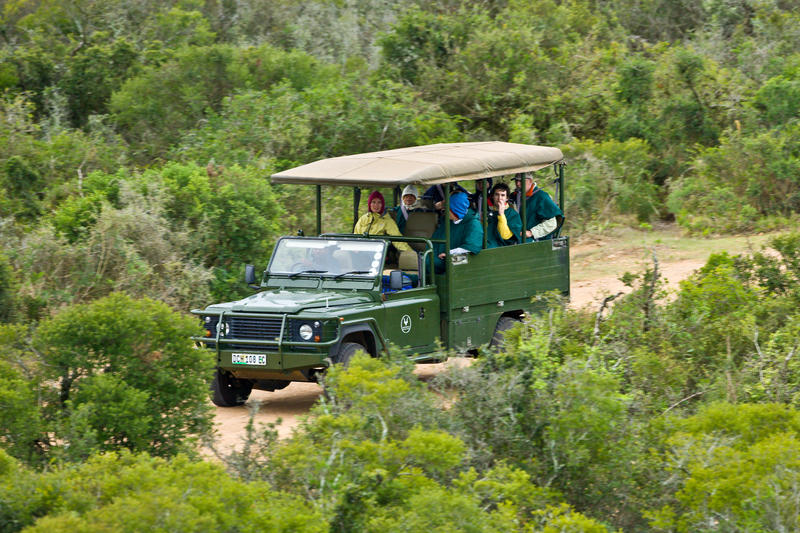
The Shamwari Private Game Reserve is located on the Garden Route in the Eastern Cape, about an hour’s drive from Port Elizabeth. The reserve is a conservation orientated 5-star safari holiday destination and is malaria-free. It is home to vast herds of wildlife, birdlife and incredible ecological diversity. Five of South Africa’s 7 biomes are found here. The Shamwari Private Game Reserve is an award-winning 25, 000 hectares of protected land and a pioneer in environmental education. On top of all this, the reserve has plenty of activities on offer that you can enjoy.

Photo Credit: Their website.

Ornithologists and bird watching hobbyists alike will be delighted to hear that the reserve has an array of birds, such as Black Shouldered Kites, Secretary birds, African Darters, Malachite Kingfishers, Black Harrier and many more. Their game viewing drives are available for morning and evening trips as this is when the animals are most active. The drives are guided by trained game rangers who’ll take you and your party through the reserve, encountering many animals along the way.

If you’ve got children, they have the opportunity to learn about the importance of nature conservation as well as have buckets of fun in their Kids on Safari programme. While the children are occupied, you can spend some time relaxing at their safari spa, which will leave you feeling revitalised and rejuvenated.

Photo Credit: Their website.

We hope that these game reserves have piqued your interest. Whether you’re having a holiday in Cape Town, Port Elizabeth or KwaZulu-Natal, these reserves are not too far away. Each reserve has its own unique potential for great and memorable experiences. Get in touch with our consultants to book your next vacation!

Checklist for Safe Travel with Your Kids in Southern Africa

Travelling in Southern Africa with your kids can be a truly rewarding adventure and help you build lifelong memories, but it also requires a much more elaborate preparation. Safe travel is key. That’s why our team of experts (and parents) have decided to put this article together in order to help you optimise the chances of living a unique and worry-free experience. In this article, you’ll find ideas and advice. Hopefully we will answer any doubts or questions that the organisation of such an adventure might raise.

Here’s our check-list to ensure a safe, exciting travel with your kids:

  1. Check your children’s passport validity. Keep an eye on South Africa’s entry requirements as they currently require parents to travel with an unabridged birth certificate.
  2. Be aware of any food and drink safety recommendations during your travels.
  3. Be informed about the local climate, for both day and night.
  4. Choose your accommodation wisely. Consider that amenities like a swimming pool and other activities will be fun for your children. Moreover, some lodges in private game reserves provide baby-sitting and childcare services, so do your research about your accommodation and plan accordingly.
  5. For parents travelling with toddlers, it is advisable that you bring some of your own equipment. For example, a noise machine, a nightlight or even a childproofing kit (power plug covers, foam corner guards, etc.) are all things that would be useful to bring.
  6. Check that all planned activities are accessible to the whole family (take into account age limits, height limits, specific licenses required, etc.)
  7. Make sure to introduce the itinerary to the children before travelling. That will reassure and motivate them while giving them instructions to follow and rules to respect (concerning attitude during visits, behaviour towards animals when on safari, etc.).
  8. If you intend to drive a lot, make sure the travel distances remain acceptable and bearable for children. (We suggest between a two and a half hour to a three hour maximum travel time)
  9. Bring things that will occupy them during the journey,  such as reading, holiday notebooks, travel journal, or music to make sure they’re always busy.
  10. Think about buying snacks in advance that meet your and their specific cravings. Different countries have different snack foods!

Chat to our travel consultants on tailor-making a trip perfectly suited for you and the ages of your children.

By Xavier Lopes

What to Pack for the Wild

While going on a journey to the great outdoors inspires to a simpler way of life and a return to necessities, the packing for such trips is nothing close to simple. Imagine your suitcase becoming a giant puzzle that you must assemble perfectly to optimise your experience on site. There is always a struggle of finding the perfect combination of clothes and accessories and making them fit into your luggage that seems to be getting smaller and smaller as you start thinking of scenarios in which you would need this and that.

Photo Source: Pinterest & Ofonime Essien Aviation

Well, at Travel By XO, we understand your worries and this is why we have prepared this checklist on what to pack for your adventurous journey through Southern Africa.

LUGGAGE

There are three main types of luggage that you will need. The first is a large soft bag, which is mandatory when flying with chartered airplanes, especially in Botswana. Choose a resistant and flexible bag as most small aircrafts store the luggage in a very small compartment.

The second item you’ll need is a backpack. It’s the most comfortable way to bring as many accessories as you can along on your adventures.

The third item is a small money belt: the necessary choice if you are transiting through smaller, less frequented airports or visiting some bustling local popular markets to purchase authentic souvenirs.

CLOTHING

Remember that you are going into the wild and that wild animals will be roaming around you. It is recommended to only bring green, beige, khaki, brown or grey coloured clothing along. You want to blend into nature in terms of the colour scheme as much as you can. Curiously, blue and black attracts tsetse flies while red and white attracts most animal’s attention!

Photo Source: Fashion Me Now & The Safari Store

Clothing Checklist

  • 1 pair of comfortable closed walking shoes: ensure that you have worn them before your trip if you are planning long enjoyable walks and hikes or even want to attempt a walking safari.
  • 1 pair of sandals – in Southern Africa aside from hot wonderful summers even winter and autumn can spoil you with warmth and sunshine so to enjoy pool, beach and surroundings always pack a pair for just in case.
  • 1 tight fitting hat to avoid nasty sunburns
  • 1 comfortable pair of sunglasses so you can enjoy the beautiful sights of animals and landscapes even in sunshine
  • 2-3 pairs long pants and 1-2 pair of shorts
  • 2-3 tee-shirts as well as 2-3 long sleeved shirts
  • Sleepwear and underwear
  • 1 smart-casual outfit to dine at the lodge (opt for long sleeves and long pants to avoid insect bites)
  • 1 windproof jacket with a warm inner lining
  • 1 scarf and a 1 woolly hat and gloves for travel during the winter
  • 1-2 sports bras: the game drives can be rough going through unfenced terrain (you’ll thank us later for this tip ladies)
  • 1 swimming costume

ESSENTIAL ACCESSORIES

Toiletries

Aside from your beauty case containing all the essentials you use daily, we want to just point out not to forget high factor suntan lotion, as the African sun can be harsh on your skin. You will also need a moisturizer as the wind in, for example, Cape Town can be quite drying. Pack a long lasting lip balm and when packing razors, we recommend non electric options. Please also stay away from strong smelling beauty products or perfumes on safaris as you don’t want to attract the attention of animals.

MEDICINE

  • Anti-histamine cream & tablets
  • Painkillers
  • Any personal medication (including malaria medication) should be carried with you at all times.
  • Foreign foods don’t agree with everyone so make sure to pack something for any gastric issues you may encounter on your journey to ensure that your tummy won’t get in the way of your well-deserved holidays.

Photo Source: Istock – 101 Ways to Survive

Other useful essentials

  • Cash in moderation
  • Camera – with charger, spare memory cards & battery
  • 1 pair of binoculars per person
  • 1 torch per person
  • 1 adapter for the plugs in South Africa

Photo Source: Silverkris

By Lou Zagagnoni

South Africa beyond a Safari

If when someone speaks about South Africa, you immediately think about wild animals in the middle of the African savannah or if every time someone says to you, “I’m going to South Africa for the holidays” you answer back, “Oh nice, you’re going to go on a safari!” Take a few minutes to read this article and you will understand that it’s a shame to reduce such a beautiful country to only one activity, no matter how incredible it is!

In this country, there is something to satisfy everyone’s tastes. Adults, young and old, couples, families, retirees, athletes, nature lovers, musicians, foodies, everyone—yes I do mean everyone—can find something in South Africa to their taste! It would be tedious to list every place, landscape or activity in the country. However, let’s try to highlight the peculiarities of South Africa to introduce you to something other than a safari!

First of all, you should know that South Africa is a really BIG country, which deserves to be captured differently depending on where you are. Indeed, if you travel in Western Cape, Kruger Park or KwaZulu-Natal, you will see very different landscapes, animals, climates and cultures! It’s certainly relevant to speak of bush but we shouldn’t forget that South Africa also has amazing beaches, mountains, lagoons, dry deserts, and vineyards as far as your eyes can see.

Yes really, you’ll never get tired of this country! If there are landscapes to suit every taste, imagine how many activities there would be for you to do! Let’s start with what seems more obvious: the beaches in South Africa. South Africa is home to two oceans and thousands of beaches. Below the mountains, hidden between cliffs, spreading as far as your eyes can see, it’s up to you to find your small corner of paradise! For those who can’t stand lying on the beach, you have the chance to do many water activities such as surfing or windsurfing, swimming with seals, watching the whales and even shark-cage diving… the list goes on.

For those who love nature, the Drakensberg Mountains in KwaZulu-Natal is the place where you belong. Choose a path and explore this huge nature reserve for several days. You will enjoy a very unique experience in harmony with nature. Or maybe you’re more attracted to Table Mountain? You will definitely enjoy a breathtaking view of Cape Town from the top!

Don’t worry! If you prefer the excitement of the city and cultural visits, the major cities of South Africa—Cape Town and Johannesburg—are perfect for you. Through visiting many museums (the Slave Lodge in Cape Town and the Apartheid Museum in Johannesburg, amongst others), or wandering in the different districts (townships, sea side, CBD, etc.), you will feel the strong influence of history that is still very present in this country.

There is nothing better than interacting with locals, discovering their habits, their ways of life and state of mind to have a truly accurate overview of these cities. Eventually, it’s crucial for you to know that South Africa takes food very seriously! Once again, there is something for everybody: whether you’re at a South African specialties or indulging in some international food (Asian, European and more) in a themed restaurant (jazz, hipster, pub) or in a casual market, you will be completely overwhelmed! This culinary diversity can be coupled with a huge range of excellent wine produced in the Winelands of Cape Town. If you have the chance to visit these vineyards, you will discover wonderful properties that have absolutely nothing to envy from all these castles in Bordeaux (in France)!

There you are. You now have a modest preview of what is waiting for you in South Africa. Go ahead; come discover a country that will blow your mind!

And never forget, going on safari is an excellent reason to visit South Africa – but hardly the only one!

By Capucine Motte

Kapama Game Reserve

Nestled between the Blyde River valley and Kruger National Park, Kapama Game Reserve is one of South Africa’s largest privately owned game reserves. Renowned for its high density of big game animals, offering an authentic African safari experience and stretching across 15 000 hectares (towards the Kruger area), Kapama Private Game Reserve embodies a range of stylish accommodation across four diverse luxurious bush camps and lodges. Each one is meticulously positioned within this wildlife sanctuary.

The flagship Kapama Karula, with its 10 luxury superior villas and 2 family villas are positioned along the Klaserie River or tucked into the surrounding riverine bushveld, each in its own private paradise with a heated plunge pool and viewing deck.

Reminiscent of a traditional African safari camp, Kapama Buffalo Camp offers an authentic bush experience. The camp’s 10 exclusive tents are positioned on elevated platforms and surrounded by forest canopy.

Located in the reserves extreme south, the spectacular Kapama Southern Camp offers luxury-thatched suites. All 25 suites are discreetly hidden in the surrounding indigenous forest that’s alive with birdsong. Families are catered for at Southern Camp, with three luxury villas specially created for this purpose.

Kapama River Lodge the largest of the four camps, with flowing, opulently furnished public spaces and an expansive wooden deck leading to a rim-flow swimming pool. Beyond is an expanse of soft river sand, where atmospheric, lamp-lit dinners are enjoyed under the stars. Guests may choose between luxury, spa, spa family or Royal suites.

Wellness Centers are located at Karula and River Lodge, so a pampering for body and mind is close at hand. With up to five treatment rooms, indulging in one the numerous African Inspired treatments will take you to a place away from time. A shuttle is available to commute guests from Southern Camp and Buffalo Camp allowing guests from all lodges to have access to these world class award-winning spas.

Kapama is known for its diverse wildlife experiences and is home to the Big 5. With two daily game drives, fascinating encounters with prolific wildlife, including over 350 bird species and over 40 species of mammals is ensured.

Kapama offers free transfers for guests flying into Hoedspruit airport on commercial flights. The short transfer from the airport to your designated lodge is in an open-air safari vehicle. This means within a matter of minutes your safari adventure can begin.

For the discerning traveller wanting a more luxury, private and customized travel option, Kapama’s private airstrip and PC12 private plane gives guests the opportunity to fly directly into Kapama.

By Nicole Walker

7 Tips for Enjoying Your Safari

1. Bring warm clothes with you

Always take a fleece and a scarf, among others. Surprising? Yes it is Africa, it’s hot, the sun can be relentless, but do not forget the freshness of an early morning and a game drive in an open 4×4! So, take these along to protect you against the biting morning cold. A small thermos of coffee or tea would help as well. This impression of cold will quickly dissipate with the rising sun, trust us.

2. Take your time

A safari can be the fulfillment of a dream and undoubtedly the main highlight of your trip. So it would be a pity not to dedicate enough time and give you the best opportunities to see the greatest number of animals. Therefore, we advise you to stay at the same lodge, in the same park or reserve for at least 3 nights to get the most out of your safari experience.

3. Spend at least 2 nights in a private reserve

A self-drive safari is a bit like reading a book in which you are the hero (those who have children understand!). However, a deep learning of the bush, recognising and understanding the animals of the African wildlife in the company of a professional ranger is, from our point of view, an experience not to be missed. Not to mention, a personalised service provided by an attentive staff will maximise your enjoyment, especially if you are travelling with children.

4. Live in harmony with nature

Be aware, forget lazy mornings in safari! The best time, indeed, to see the animals and especially the famous Big Five (lion, leopard, buffalo, rhino and elephant) is at sunrise and during the last hour of sunlight. Don’t worry, you will quickly adapt your rhythm with mother nature’s one. This will also grant you some good breaks during the hottest hours of the day. Use this opportunity to have a swim in the lodge’s pool, for example.

5. Observe the speed limit

Respect the animals you came here to see to give you the best chances to see as many animals as possible. Believe us, you can drive pass an elephant without noticing its presence in spite of its mass. Finally, it’s all about your and your children’s safety. Hitting a hippo can cause heavy damages. The common speed limit is 50 km/h on tarred roads and 40 km/h on all other roads and tracks.

6. Stay calm, animals don’t really care about you

A lion is approaching your car? You come across a herd of elephants? A buffalo is sitting right in the middle of the road, determined not to move and preventing you from driving on? In all circumstances, keep cool and stay calm. Animals are used to cars. Never make any sudden movements, shout or make abrupt manoeuvre with your car. They will always get out of the way 😉

7. Be in the right place at the right time

We saved you the best and maybe the most difficult for the last as it’s not really in your hands: be in the right place at the right time 😉 Remember, animals are in their natural element and actually wild, so be armed with patience and also count on your lucky stars.

By Sébastien Charrieras

Strange, Beautiful Namibia

It might be a mirage or a ghost ship. Laid down on the sand, where the desert meets the ocean, is a cargo boat that ended up on Namibia’s shore a few years ago. It has started its long disintegration by oxidation, like hundreds of others along the Atlantic coast. Half immersed, or eaten by sand, run-aground shipwrecks lie strewn along the Namibian coastline.

This region is charmingly called ‘Skeleton Coast’ (it is, in fact, a National Park since 1971), although it wasn’t originally named for its shipwrecks, but for the whale and seal bones that once littered the shore as a result of the whaling industry. The Bushmen called it ‘The land God made in anger’ while Portuguese sailors one referred to it as ‘The Gates of Hell’. Unless you are cut out for adventure and decide to join an expedition, the northern part of Skeleton Coast is very difficult to access and can only be visited by plane.

Further South, in the Damaraland, you can go through the desert with a four-wheel-drive vehicle to discover the fascinating wildlife. In this country of extremes, strangeness is also in animal life. At first there are safaris. They take on a new dimension in this region because all the animals we are used to seeing in the bush live here in the desert: elephants, black rhino, lions, cheetah, giraffe, brown hyena, etc. Besides these mammals, there are also all these curious beings that need to be approached gently. Small, camouflaged, furtive; yet they are incredibly captivating!

For example, take a look at the Palmato Gecko, the endemic gecko of the Namib Desert: with its cute face, pastel colours and habit to lick its eyes with its long tongue in order to keep them moist (they have no eyelids), they are adorable. Or the Namaqua Chameleon, who certainly hasn’t got the nicest physique, but possesses very interesting characteristics: they are lightning fast with extraordinary mobile eyes, skin that changes its colour according to mood or temperature, and a tongue that reaches a length of up 30 centimetres! Anyway, this is just an overview of the peculiar fauna living in this land. But to find and approach them, you’ll need a guide.

Photo Source: Manfred W

Definitely the land of strangeness, Damaraland also houses a very rare plant: the Welwitschia Mirabilis, with remarkable longevity and constitution. It lives for up to 600 years on average, but 2,000-year-old specimens have been found. Concerning its appearance and its impressive size (the biggest Welwitschia is 1.40 metres in height and 4 metres diameter), it hides a disconcerting simplicity: it only possesses two leaves which grow constantly, making it look like a giant squid.

Finally, when we talk about Damaraland, we can’t forget to mention the Spitzkoppe, the huge rock standing in the middle of the desert which offers an astonishing landscape. The 700 million-year-old group of bald granite peaks with a highest outcrop of 1,784 metres, extends as far as the eye can see.

Photo Source: Maurits Vermeulen

The list of uncommon and weird things you can find in Namibia doesn’t stop there. This is just an introduction for curious people. From there, it is time for you to discover this country and its hidden treasures by yourselves. We’ll be delighted to create a peculiar adventure for you.

Photo Source: ka.hi

By Muriel Romero

Lesser-known Animals You May See on Safari

There is nothing like a safari for wildlife spotting, and southern Africa in particular is blessed with the best – from the Big Five to everything in between!

And sometimes, on safari, you chance to see a new creature, which really makes you stop and stare or ask aloud in wonder, “What was that?”

This post is dedicated to those lesser-known – but no less amazing – African animals.

Africa’s Wild Dogs

Photo Source: cuatrok77

While many of us have no doubt heard the distinct call of an African wild dog when in the bush or on safari, not everyone is lucky enough to have actually caught sight of them.

Sadly, African wild dogs are Africa’s most endangered carnivore. This means that, despite their fierce spirits and keen hunting ways, many of them are now under tight protection or are being bred in animal sanctuaries, like the Ann van Dyk Cheetah Centre.

Yet, even with these trying life circumstances, this beautifully marked dog species is particularly prevalent in South Africa’s Kruger National Park… So if you are likely to spot them anywhere in Southern Africa, it’s going to be in the Kruger.

Africa’s oh-so-adorable Lesser Bushbabies

Photo Source: pelican

The Lesser Bushbaby – found predominantly in South Africa’s Mpumalanga and Northern Cape provinces, as well as in Botswana – is an adorable, tree-dwelling primate, which, above all else, is cute as pie and most active at night.

So, if you hear something like a child crying (although slightly more unnerving, it must be said) while out on safari… It’s actually good news because it means you might be close to a bushbaby. This is because they emit somewhat eerie, childlike cries!

Capable of remarkable leaps from tree to tree (although they sometimes take to the ground too), these adorable nocturnal creatures are a nice, unexpected sighting on any safari experience… if only because of their wide-eyed fluffiness. You’ll have to be quick though because they don’t hang around for long!

Spiky African Porcupines

Photo credit: Cape Point Route

Quilled – and generally, rather grumpy – African porcupines are easily identifiable thanks to their impressive black and white quills, which they raise upright if they are exhausted or angry. What’s more, these beautifully marked quills are often left behind on the ground after them, helping to let you know where a porcupine has been.

African porcupines (which are Africa’s largest rodent… who’d have thought?) may be found in North, South and East Africa. However, they do tend to favour rocky outcrops and vegetated or hilly areas, where they can seek out shelter and perhaps above all, seclusion.

Also, they are not too frequently sighted, but porcupines are most active at night (although, if you’re lucky, you can sometimes spot them moving about during the day) …

So, when you head out on a night safari drive, be sure to keep an eye out for them just in case!

The elusive and endangered Cape Pangolin

A bonus, lesser-known animal on this list is sadly also one that is gravely endangered… In fact, the shy and elusive pangolin is one of the most heavily trafficked animals in the world – with the Asian varieties particularly facing rapid extinction.

Despite its reptilian appearance, the Pangolin is actually a mammal and when they roll themselves up into a ball, their suit of scales (which is also, sadly, why they are hunted) makes them almost impenetrable to outward dangers.

While it is extremely rare to sight one of these unusual looking fellows in Southern Africa because of their elusiveness as a species, it is still possible to see them. This is because one of the four African varieties, the Cape, or Temminck’s Ground Pangolin, calls this part of the world home.

They might not be the most adorable animal to look at (let’s admit) – the Cape Pangolin is nevertheless a worthy sighting on any safari – and you can count yourself very lucky indeed if you chance to see one out in the bush!

Photo Source: www.independent.co.uk

Leopard Tortoise

The leopard tortoise is a large tortoise found in the most varied habitats of any African tortoise including grasslands, thorn-scrub, mesic brushland, and savannas. They occupy savannahs of eastern and southern Africa, from South Sudan and Somalia to South Africa’s North West Province, the Western Cape, Eastern Cape and Northern Cape. It is one of the Small 5, along with the rhino beetle, the red-billed buffalo weaver, the elephant shrew and the antlion. They can live for up to 75 years. In extreme cold and extreme heat, they dwell in abandoned fox, jackal, or aardvark holes.

Photo Source: Michael Seeley

As they are herbivores, the diet of the Leopard Tortoise includes plants including grasses, annuals and succulents. They also gnaw bones and hyaena faeces. The high calcium content in this provides essential minerals to aid eggshell production and to keep the tortoise’s shell in good condition.  During the dry winter months, leopard tortoises store water in a bursa sac. This reserve is used to moisten baked ground to make it easier for the female to dig a nest for her eggs, as well as hydration. Do not pick up a leopard tortoise during the winter months, as they will eject their stored urine and water as a deterrent. This could dehydrate the tortoise and they could die. So if you ever come across one of these magical creatures in winter, look but don’t touch!

Bat-eared Fox

The bat-eared fox lives in the short-grass savannahs of eastern and southern Africa. Their favourite food is the harvester termite, although they also eat insects, small rodents, lizards, small snakes and wild fruit. When they are fully grown they can reach a shoulder height of 30 centimetres, with a length of 75 centimetres and weighing less than 5 kilograms.

Photo Source: Jason Matthews

Much unlike other dog species, bat-eared foxes do not mind sharing their territory. Their cubs are born after a 2-month gestation period. Bat-eared foxes also pair-bond for life. They do not make much noise in general, but they do bark, growl and whine. They communicate with each other using shrill ‘who-who who’ calls.Unfortunately, the survival of the beautiful Bat-eared Fox is threatened by a loss of their natural habitat and by the trade in their skins. Next time you see one in the wild, know that it is a great privilege.

So, next time you are on safari, don’t just focus your camera and eyes on the Big Five… keep a conscious look out for these unique creatures too, for they are just as photogenic and interesting to see!

Safari chat with a Sabi Sand Game Ranger

Below is an interview with Greg. He is 36 years old, and is a game ranger in the Sabi Sand Private Game Reserve. He tells us about safaris and tries to give us a clear insight into them.

Tell me about yourself, your career path and your current job.

Greg: Well, I was born in Johannesburg. But I was lucky because as far as I remember, I was going to safaris with my family every holiday. The bush quickly became my passion, so I decided to turn it into a job. First, I was a guide for years in the Kruger National Park where I organised walks. Then I worked in several reserves and now I’m here. It is in the bush that I feel good, and I don’t think that I will leave this place anytime soon.

How are the safaris here?

Greg: Here, we offer two safaris a day, one at dawn, very early in the morning around 5, 5:30am and the other in the afternoon; 3:00 pm in winter and 4:00pm in summer. We use open 4×4 vehicles to take the guests to see the wildlife, which is the best way to enjoy the view and take pictures. Sometimes we do safaris by night, but we do not always offer it.

Can you see animals each and every time? Or it is still a matter of luck?

Greg: Sabi Sand Game Reserve is one of the best sighting spots for game in the country. So, we are not really looking for animals. Sometimes, after a few minutes of driving, we find lions and leopards, and even sometimes all the Big Five! But Sabi Sand Game Reserve is obviously special. I have worked in other reserves and there, we kind of know where the animals are. Most of them are not really nomadic and they remain in their territory, so we get to find them. But we always need to be on the lookout for them and follow the tracks. But it’s true; it’s also a matter of luck! Sometimes we do not see all the animals we wanted to. Sometimes we’re looking for them for a long time. That’s the law of nature.

And for very large reserves, some rangers need to communicate. If someone finds a lion or something else, he usually lets the others know, and so on. In short, everything is done in order for the guests to see as many animals as they can, but they must also understand that it is not always possible, and it is not our fault. And sometimes, it takes more time than expected.

Is it not too dangerous to work in the middle of wildlife and organize safaris?

Greg: Oh, I’m glad you are asking that question! I just wanted to talk about it. Here in the Sabi Sand Game Reserve, and even in most reserves, the animals are now accustomed to humans. Well, I should say they are used to seeing 4×4’s! They know we’re not a threat, so they do not attack. But it took time, about fifteen years. Now, when our cars make a hellish noise approaching a lion, sometimes it does not even look up. But you can’t generalise, they still remain wild animals and in the wild, you never know what can happen.

Sometimes I have clients who want to get off the 4×4 to closely approach the animals, take a picture of them and come back into the car. You can even see in the Kruger Park, people leave their cars on the side of the road and start walking on foot in the bush! These are attitudes that are unconscious and dangerous. We, rangers, always have a gun if something happens. Here, it’s forbidden to walk alone and even at the Lodge you must be careful. There are rules for safaris: remain silent and wear neutral colours. So, in short, it is not really dangerous, otherwise safaris would not exist! But we need to be aware that all animals here are still wild animals, and yes, if someone walks all by himself or starts to display reckless behaviour and tries to pass for a hero by getting out of the 4×4, then, it is not safe.

What do you think the tourists don’t expect on safari?

Greg: I think that they are often surprised when they see really violent scenes. Sometimes customers do not expect this. Hunting scenes with leopards slaughtering antelopes, crocodiles ripping a leg off of a buffalo, or when wild dogs hunt, etc… Sometimes the guests think they will see a peaceful bush where all animals live in harmony, like, let’s say the Lion King movie. But no, the law of nature is cruel, and wildlife is violent! But it is also what makes it so interesting.

By Sophie Pollet